22 meetings in Bilbao: What BIOSPAIN 2026 told us about Spanish biotech
22 meetings in two days. That was Inveniam’s agenda at BIOSPAIN 2026 in Bilbao, and those conversations told us a lot about where Spanish biotech stands today.
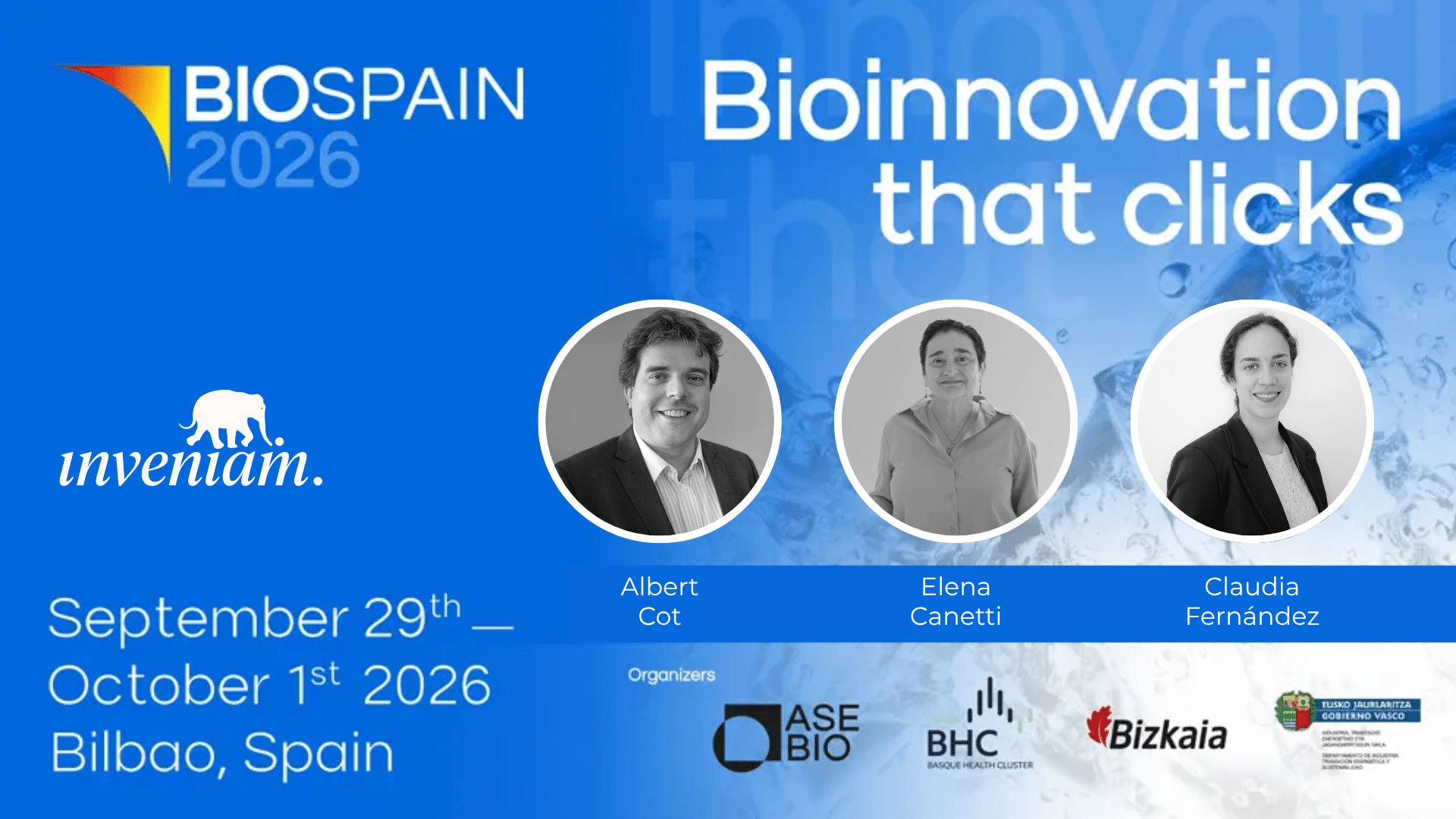
From 29 September to 1 October, the Bilbao Exhibition Centre hosted BIOSPAIN 2026, Spain’s largest biotechnology event and one of Europe’s major meeting points for the sector. Our partners Elena Canetti and Dr. Albert Cot travelled there together with Dr. Claudia Fernández, our Head of Strategic Consulting.
The programme ran across four tracks (Policy, Health, Bioeconomy and Finance & Investment) and addressed recurring challenges: how to speed up technology transfer, how to grow advanced manufacturing and how to get companies, research centres, public administrations and investors working together. The final day was dedicated to Talent Day, which connects companies with specialised professionals.
We spent most of our time in the partnering area. Here is what we heard.
Research institutions and the challenge of prioritisation
More than half of our meetings were with the institutions that generate the science: national research networks, cancer and biomedical research centres, hospital-based health research institutes, university technology transfer foundations and technology centres, including organisations based in Galicia, the Basque Country, Madrid, Catalonia and Andalusia.
They have plenty of technology. What they are short of is time and people to decide what to do with it. Portfolios run to dozens or hundreds of projects at different stages of maturity, managed by small transfer teams. The questions they brought to the table were very practical. Which technologies have a clear market? For a potential therapy, what should the first indication be? When does a spin-off make sense, and when is licensing the better route?
Startups balancing funding with commercial decisions
The second group of meetings was with young companies, most of them born in universities and research centres. Their technologies ranged from advanced therapies and diagnostic approaches to novel biomaterials and medical devices.
Despite their different technologies and stages of development, they shared a similar approach to funding. None of these companies is planning its next round on private capital alone. They estimate what investors will put in and close the gap with non-dilutive instruments such as NEOTEC, EIC Transition or the EIC Accelerator, timing each application to a specific technical or regulatory milestone.
Other topics came up that rarely get attention until they become a problem: the IP licence agreement with the parent institution, the move from a services model to a product model, and bringing key profiles such as a CTO into teams that sometimes have one or two people.
Industry and investors looking for the right opportunities
Private capital was present too, often syndicated across several funds to limit dependence on any single investor. Earlier-stage projects, still close to their originating universities, are looking to tech transfer funds under the CDTI/EIF initiative and business angels for that first seed round.
Our meeting with one of Spain’s leading pharmaceutical groups showed the other side of the ecosystem. The company invests in and co-develops projects from idea to clinic, always within clearly defined therapeutic areas. For a research centre or a startup, that changes the pitch: a handful of well-matched projects will go further than a broad, unfiltered portfolio. That was the logic behind the scouting projects we presented to the company.
On the investor side, we also met Spanish venture capital firms active in life sciences and saw how some research centres now run their own in-house vehicles to spin out and fund new companies.
We also met firms whose work complements ours, from law firms specialised in regulatory affairs and US expansion to AI-driven data platforms for competitive intelligence or specialised international CROs. Many biotech companies need these services at some point, and it pays to know the providers before the need becomes urgent.
Three takeaways from Bilbao:
- The bottleneck we heard about most often lay in selection rather than science. Research institutions have promising technologies but often lack a systematic way to decide which projects move forward, in what order and with what resources. In our view, early technology assessment and market validation with real customers make the biggest difference at that stage.
- Public and private funding belong in the same plan. An EIC or NEOTEC application works best when it shares milestones with the investment round. The companies with the clearest strategy were the ones running a single, integrated timeline.
- BIOSPAIN conversations should continue between editions. A conversation started in 2025 can be picked up in 2026 with real progress to show. That shortens follow-up cycles and asks everyone to arrive with sharper goals.
BIOSPAIN in context
This was the third time BIOSPAIN was held in the Basque Country, a region with one of the most structured life sciences ecosystems in Southern Europe. For a sense of scale, the 2025 edition brought together more than 2,400 attendees from over 1,000 organisations, with 140 investors and around 4,500 one-to-one meetings.
Our meetings were a small part of that activity, but they offered a useful perspective on the challenges facing Spanish biotech. The conversations revealed how much work remains between identifying a promising technology and securing its commercial future, and how decisions made by research institutions, start-ups and investors influence that process. BIOSPAIN provided an opportunity to discuss these challenges directly with the organisations involved and establish conversations worth pursuing beyond the event.